◈This chapter establishes sensory evaluation as the sommelier’s core discipline and codifies the Court of Master Sommeliers Deductive Tasting Format — a structured four-step assessment that reasons logically toward a wine’s grape, origin, age and quality.
From the book
Real Pages From This Chapter
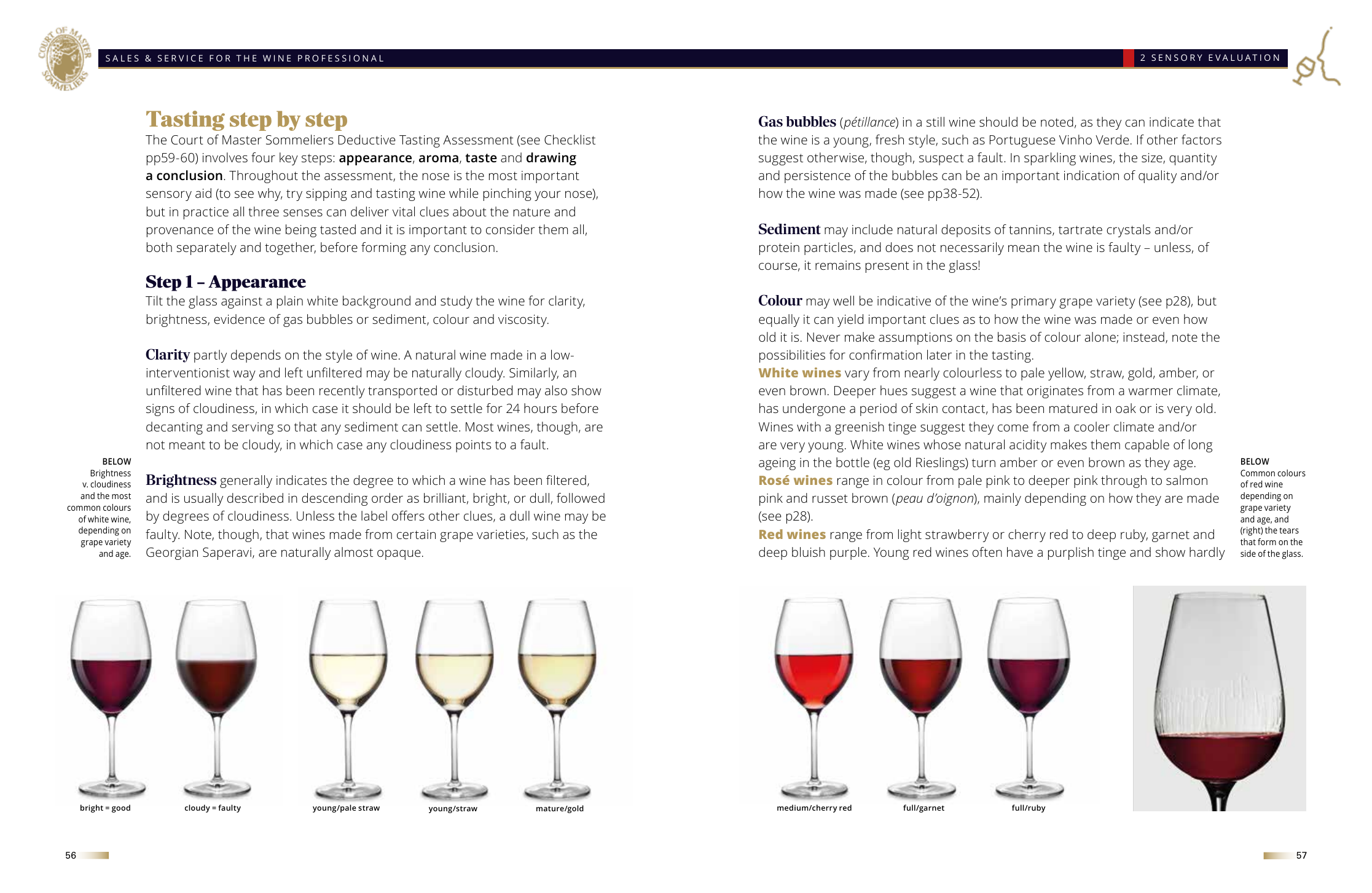
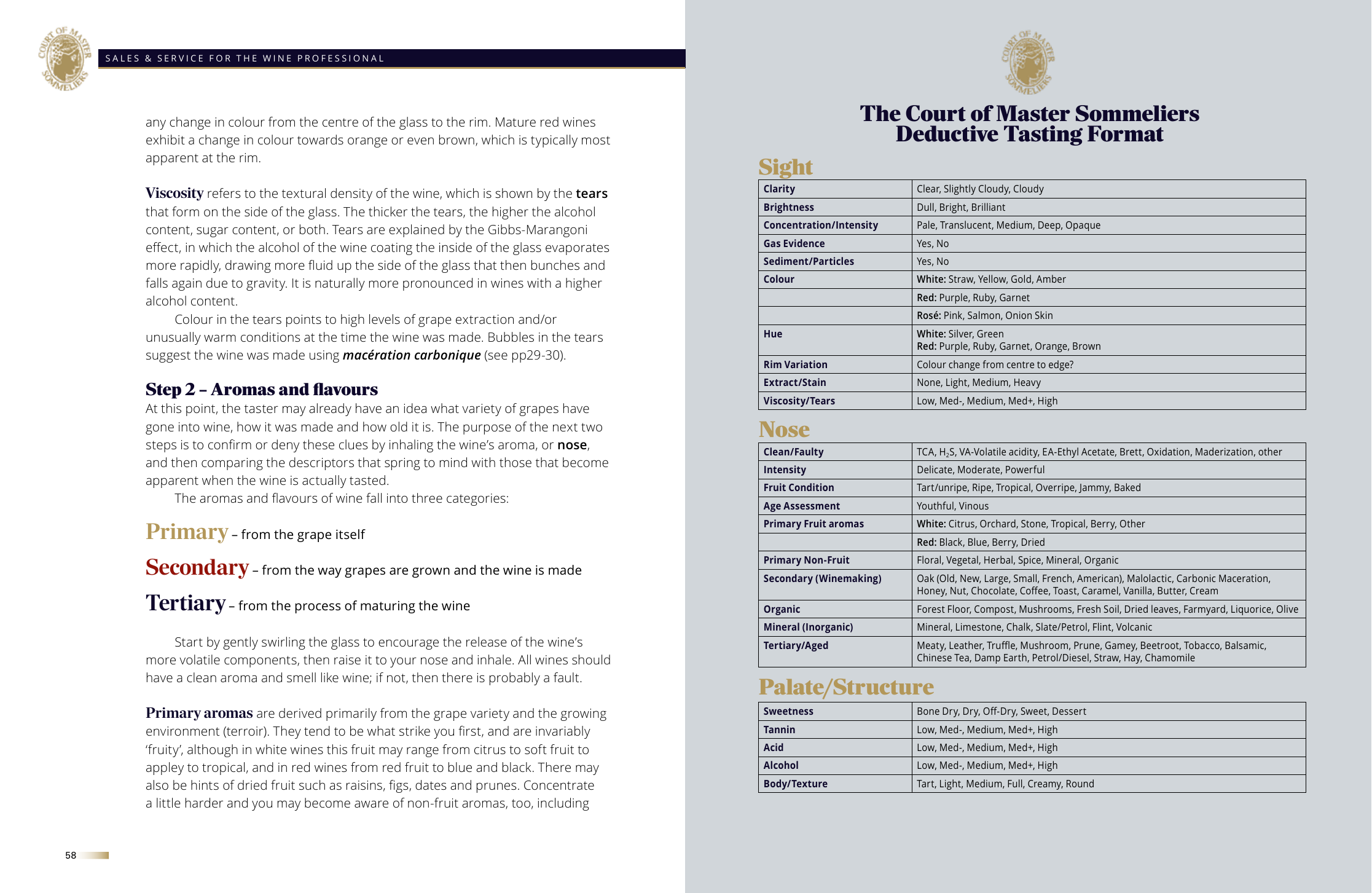
Tasting step by step — appearanceThe CMS Deductive Tasting Format
◲ Tap any page to read it full-size
Why this chapter matters
What You’ll Learn
Carry out the CMS four-step Deductive Tasting Assessment — appearance, aroma, taste, conclusion — in the format examiners expect.
Read a wine’s appearance against a white background and turn each observation into a defensible deductive clue, not a guess.
Assess structure on the palate — fruit, acidity, tannin, alcohol, finish — and use that balance to judge quality and ageing potential.
Identify the faults a sommelier must intercept before service — corked, reductive, volatile acidity, oxidation — chiefly by nose.
◈ For your CMS exam
Must-Know Facts
The Deductive Tasting format runs in fixed order: appearance, aroma, taste, conclusion; the nose is the single most important aid.
‘Corked’ wine is caused by TCA (2,4,6-trichloroanisole) tainting the cork — a musty, cardboard smell.
Body by alcohol: full-bodied wines exceed 14% abv; light-bodied wines are 11% abv or below.
A long, balanced finish is the surest mark of a superior-quality wine.
What This Chapter Covers
01
Purpose & context of tasting
02
Step 1 — Appearance
03
Step 2 — Aromas & flavours
04
Step 3 — Taste & structure
05
Step 4 — Conclusion
06
Ageing potential & faults
Key Points
01
The sommelier should know how every style and varietal is meant to taste — shaped by grape, region and vinification — in order to describe and identify wines, including blind.
02
The Court’s Deductive Tasting Format proceeds in four steps: Appearance, Aromas & flavours, Taste, and Conclusion.
03
The nose is the single most important sensory aid, with aromas sorted into primary (grape), secondary (winemaking) and tertiary (maturation).
04
Structure is judged on the palate as the balance of fruit, acidity, tannin and alcohol; a long, pleasant finish is the surest mark of quality.
05
Drawing a conclusion is about the logic of the deduction, not merely being ‘right’ — even Masters err, but their reasoning is always sound.
“A sure mark of a superior quality wine is that its taste lingers long after the initial sampling thanks to its balanced acidity.
◈ Sommelier · Chapter 2
◈ Value for the Sommelier
Sensory evaluation is the sommelier’s working language and proving ground. Mastering the Court’s deductive format turns tasting from guesswork into disciplined reasoning — allowing the professional to assess a wine’s condition, quality and provenance, and earn the trust that defines service at the highest level.